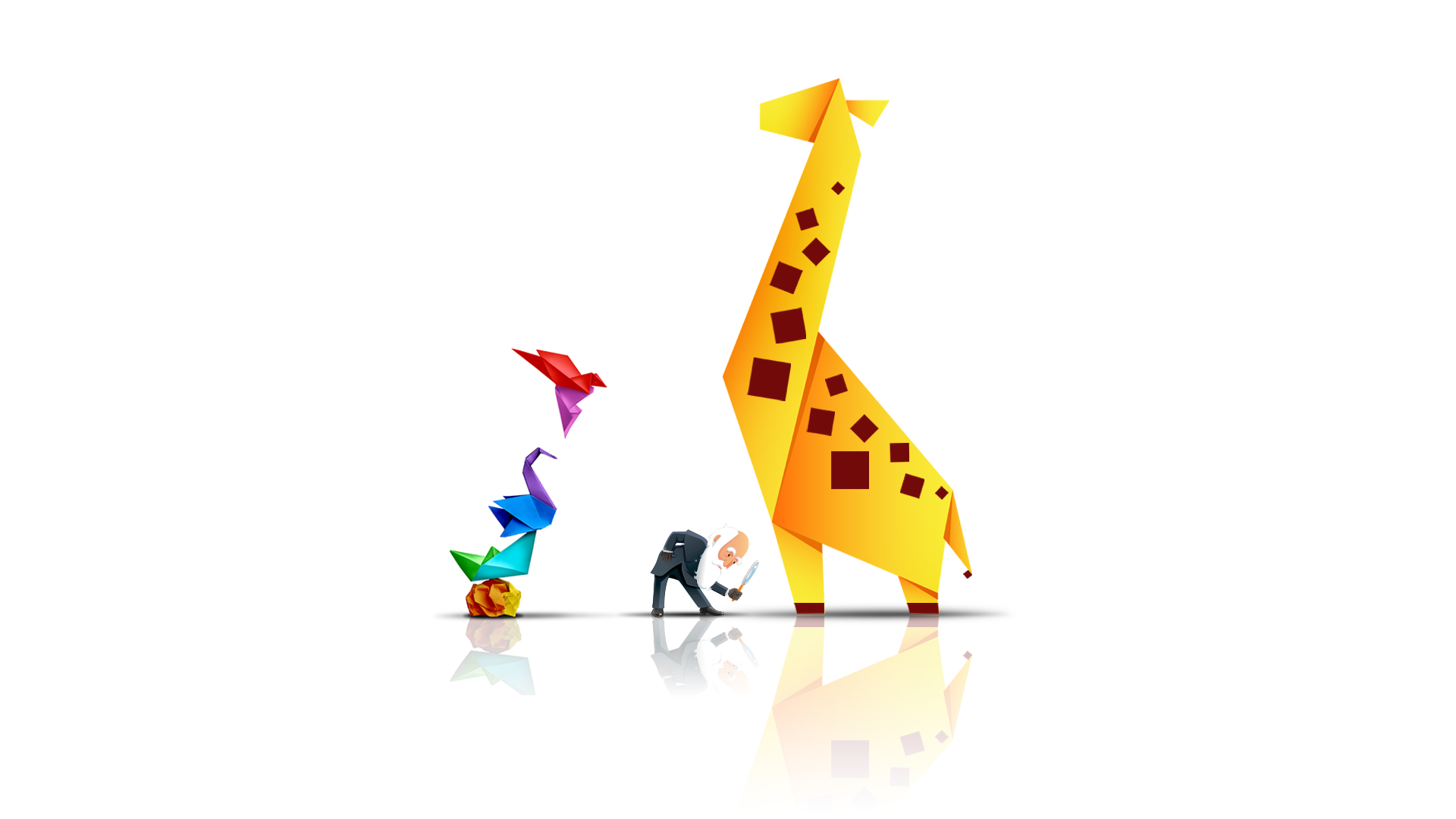

So then? Should natural selection have eliminated giraffes? Should the law of the strongest be regarded as a natural and definitive truth? Woe to the weak? What did Darwin really say? Did he “get it all wrong”?
For Darwin, nature is constantly innovating. Far from rejecting novelty, it continuously favors it. That is evolution.
He saw natural selection as a “mere” filter. It does not favor the “best” or the “strongest,” but rather those individuals best adapted to a given environmental context.
Between a systematic selection of the strongest and a natural selection of the best adapted, the distinction is considerable. One can clearly see the simplistic distortion that led to a mistaken interpretation of Darwin’s theory.
Daniel Milo reexamines it objectively. He advances an observation supported by numerous scientific studies: in reality, contrary to what Darwin has often been made to say, living systems are highly tolerant of “imperfection.” Nature constantly innovates and very readily “tolerates” a clear “lack of adaptation”… such as that of the giraffe.
Faced with the imperative demands of risk analysis in innovation, Mother Nature appears to have concluded that the giraffe posed zero risk. Adaptation therefore depends far more on a specific environmental context than on a cruel, ruthless natural selection that systematically favors the “best.”
And so the giraffe is still here. Exactly where it belongs.
A brief aside: beyond their strictly nutritional needs, species coexist predominantly in a peaceful manner. No, the “natural law” of Nature is not the law of the strongest. In light of current geopolitical events, it would be worthwhile for some to fully grasp the relevance of this observation. Thank you, Mr. Milo. End of aside.
The main idea I take away from all these reflections is the imperative necessity of objective doubt.
It would obviously be irresponsible to throw the baby out with the bathwater by claiming that Darwin “got it all wrong.” His work must be understood within the social and scientific context of his time (on this subject, see the excellent book by Graeber and Wengrow, The Dawn of Everything). It must be reread with rigorous objectivity, in order to avoid the trap of simplistic interpretations, and illuminated by the light of two centuries of scientific research and discovery.
I believe fundamentally in this requirement for objectivity.
In our relationship to humanity, to the world, and to society in general.
In science in particular, where it seems to me to be the primary and indispensable condition for constructive doubt, for research, and for discovery.
And for innovation.
Innovation. Not fearing it. Seeking it out, encouraging its emergence, treating it as a constant, but doing so thoughtfully, with genuine critical objectivity as a safeguard.
Is that not, in the end, the message Mother Nature conveys to us through Darwin’s pen?
”
Frédéric FINACEO - SD - CoFounder